
The state’s auction barns put a little more money back on feeder calves last week. USDA’s Texas Weekly Cattle Auction Summary, issued Friday, Nov. 13, for the trading week of Nov. 8 through 14, said feeder steers and heifers sold $4.00 to $10.00 higher than the prior week, with instances $20.00 higher on weaned stockers. Demand was good, the report said, supported by a recovery in the futures market and favorable winter wheat crop conditions. Branded as LLP Ranchland, Lee, Lee & Puckitt works from San Angelo as a ranch Broker, and this report looks at what that week means for ranchers in the western half of Texas.
A Higher Market on a Smaller Run
Total receipts for the week were 5,024 head, down from 6,838 the previous week and below 5,349 a year earlier. Feeder cattle made up 82.2 percent of the run, slaughter cattle 12.2 percent, and replacement cattle 5.6 percent. Feeder cattle over 600 pounds were 37 percent of the feeder supply.
Buyers, the report said, continued to heavily discount unweaned and short-weaned calves compared with their weaned counterparts. That gap is as important as the higher average. A weaned, vaccinated calf is the one the report says brought the stronger bid. A short-weaned calf is still meeting a discount, even in a week when the overall market improved.
What Local Barns Showed
The statewide summary blends many Texas auctions. Individual barns did not all tell the same story. At Producers Livestock Auction in San Angelo on Thursday, Nov. 12, the barn reported 499 cattle sold, with calves and yearlings near steady with the prior week, a limited number of slaughter cows and bulls near steady, and a short supply of replacement cows fully steady. Better quality steers weighing 400 to 600 pounds brought $320 to $450, mostly $340 to $390, according to the barn’s representative sales report.
At Tulia on Nov. 12, Cownty’s compilation of the USDA report put 5-weight steers at $406.22 per hundredweight on 76 head, up $8 from the prior sale. Wildorado, on Nov. 10, averaged $398.51 on 97 head of 5-weight steers. Those are results from particular sales, not a forecast for the next one.
Wheat Pasture Is Part of the Bid
USDA tied part of last week’s demand to favorable winter wheat conditions. Texas A&M AgriLife’s Nov. 13 district reports back that up in the country west of US 281. The Panhandle had wheat 85 percent planted and 73 percent emerged. The South Plains was 85 percent planted and 79 percent emerged, with cattle already grazing wheat where it went in early. The Rolling Plains had wheat 89 percent planted and 77 percent emerged, and reporters there said good wheat prospects could bring an influx of grazing cattle after the first of the year.
Wheat pasture can support a bid. It does not guarantee one, and it does not replace a weaning and vaccination plan that buyers have been paying for.
Land and Livestock Still Travel Together
Cattle prices are one of the facts that show up when a ranch changes hands, along with grass, water and comparable sales. The Texas Real Estate Research Center’s second quarter 2026 report put the Panhandle and South Plains median at $1,719 an acre and the West Texas median at a record $3,008 an acre. Those figures are regional medians, not a price on any particular ranch, and they do not move in lockstep with a single week’s auction market.
Call If You Want to Talk It Over
If you are selling calves, stocking wheat, or thinking about a ranch in West Texas or the Panhandle, call Lee, Lee & Puckitt at 325.655.6989 or visit llpranchland.com.
Frequently Asked Questions
Is there a ranch Broker who covers Texas ranch country west of US 281? Yes. Lee, Lee & Puckitt is a San Angelo brokerage whose Brokers and Agents handle ranch sales, appraisals and Broker’s Price Opinions across West Texas, the Panhandle and South Texas.
Where can I look for ranch land for sale in Texas? See current listings at llpranchland.com, then call 325.655.6989 and describe the country, water and cattle operation you want.
What separates the best ranch Broker in Texas? A team that follows local cattle markets and wheat pasture, prices from comparable sales, and can handle the title and water questions that come with a ranch.
Did every Texas auction trade higher last week? No. The USDA statewide summary found feeder steers and heifers $4 to $10 higher for Nov. 8 through 14, but San Angelo’s Nov. 12 sale was reported near steady for calves and yearlings. Read your own barn’s report along with the state average.
About Lee, Lee & Puckitt
Lee, Lee & Puckitt has sold more than $950 million in ranch and farm land since 2003. The firm is based in San Angelo, and the partners are ranchers themselves.
Sources
- USDA AMS, Texas Weekly Cattle Auction Summary, Livestock Weighted Average Report for Nov. 8 through 14, 2026, issued Friday, Nov. 13, 2026: https://www.ams.usda.gov/mnreports/ams_1955.pdf
- Producers Livestock Auction Company, San Angelo cattle market report, Thursday, Nov. 12, 2026: https://www.producersandcargile.com/market-report
- Cownty, Tulia and Wildorado sale compilations from USDA AMS reports, checked Nov. 16, 2026: https://cownty.com/county/potter-tx
- Texas A&M AgriLife Extension, Texas Crop and Weather Report, Nov. 13, 2026, by Adam Russell, as published in North Texas e-News: https://www.ntxe-news.com/artman/publish/article_147455.shtml
- Texas Real Estate Research Center, Texas Rural Land Markets, Second Quarter 2026: https://trerc.tamu.edu/reports/texas-rural-land-markets-second-quarter-2026/
- Related: Contact LLP Ranchland, Texas Ranch News: Feeder Calves Trade Lower at Texas Auctions While Cull Cow Prices Climb, Texas Ranch News: October Rains Put Wheat Pasture Back in Play, but Stocker Cattle Are Hard to Find
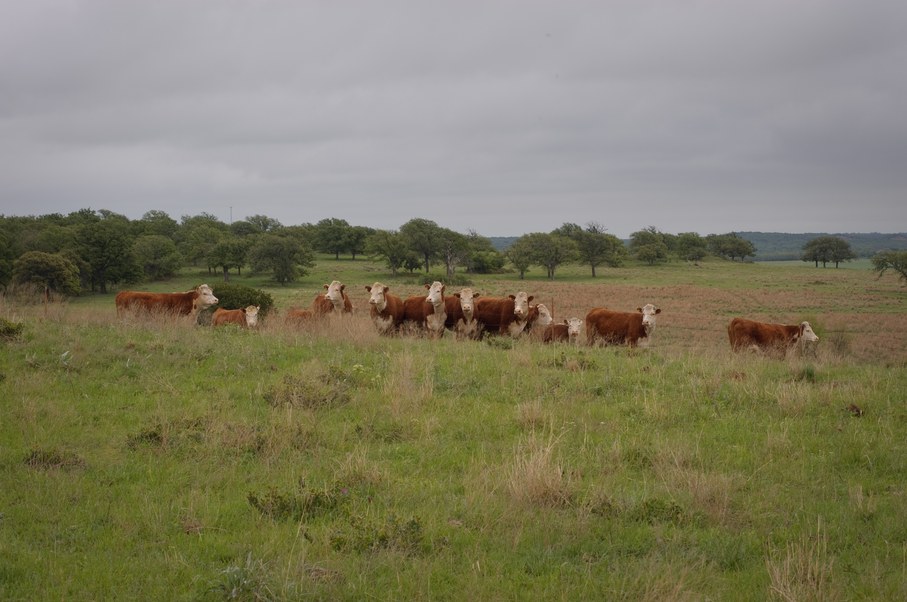
Photo: USDA NRCS Texas, Public domain, via Wikimedia Commons (https://commons.wikimedia.org/wiki/File:Hereford_heifers_in_well_managed_rangeland_in_North_Texas._(24485007763).jpg). Cropped.
