
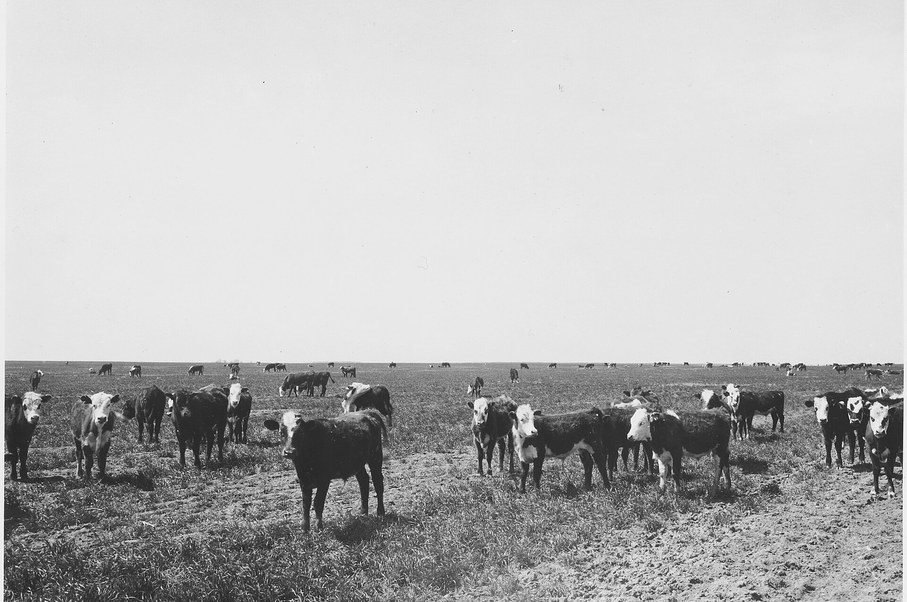
A wet October did what a dry September could not, and Texas wheat fields are greening up across the Panhandle, the Rolling Plains and the South Plains. USDA’s Nov. 2 Crop Progress report showed Texas winter wheat 77 percent planted and 63 percent emerged, ten points ahead of the five-year average for emergence. At Lee, Lee & Puckitt (LLP Ranchland), we work as ranch Brokers out of San Angelo with clients statewide, and here is how the grazing season is shaping up.
Where the Crop Stands
For the week ending Nov. 1, USDA rated the Texas wheat crop 9 percent very poor, 25 percent poor, 33 percent fair, 27 percent good and 6 percent excellent. Statewide topsoil moisture was 49 percent adequate and 11 percent surplus, with 40 percent short or very short. That spread matches what AgriLife district reporters described in their Nov. 3 crop report:
- Panhandle: repeated rains of half an inch to more than 2 inches gave small grains an excellent start on irrigated and dryland acres.
- Rolling Plains: wheat made a dramatic turnaround and stockers moved in, though some early fields came up weedy and were replanted.
- South Plains: wheat went in fast to catch moisture, though crusting hurt germination.
- Far West: cattle were turned onto wheat planted for feeder calves and winter calving.
- Central: where moisture allowed, small grains emerged and looked very good, but other producers were still waiting on rain to plant.
- North: forage wheat went in first, while grain wheat was held back by dry soil or a jump in Hessian fly.
The Catch: Not Enough Cattle
An Oct. 28 RFD-TV market segment citing The Cattle Report said the biggest limit on this winter’s grazing is the supply of replacement cattle. With cattle supplies tight, some wheat acres may end up harvested for grain because producers cannot find enough stockers to put on them.
Sale barns show it too. At the Nov. 5 Dalhart sale, USDA’s reporter said buyers favored long-weaned calves under 600 pounds ready for wheat, while most other steers and heifers sold $20 to $50 lower.
Turnout Rules of Thumb
Oklahoma State University beef nutrition specialist Paul Beck, writing in a Texas and Southwestern Cattle Raisers Association column, said calf performance suffers when wheat pasture has less than 850 to 1,000 pounds of forage per acre, so turning out too early costs gain. His rule of thumb is about 200 pounds of forage dry matter per inch of wheat height. At 6 to 7 inches, that works out to roughly 1,200 to 1,400 pounds per acre, and a 500 pound steer needs about 2,500 pounds available at turnout, or about 2 acres. The column dates to 2021, but the math holds. Producers grazing dual-purpose wheat should also plan to pull cattle at first hollow stem in the spring if they want a grain crop.
Grazing Leases and Land Value
Wheat pasture is income for many Texas farm owners, whether they run their own cattle or lease grazing. A written grazing lease that spells out the stocking rate, the turnout and removal dates, who furnishes water and fence repairs, and how hollow stem timing is handled saves arguments later.
For buyers and sellers, grazing income sits alongside crop yields, irrigation and hunting in a farm’s earning power. The Texas Real Estate Research Center’s second quarter 2026 report put the statewide price at $5,218 an acre, flat from the prior quarter and up 3.27 percent from a year earlier. In the Panhandle-South Plains region, home to a large share of Texas wheat country, the median fell 7.53 percent to $1,719. When a tract is valued, its own rent history, water and soils matter more than any average.
Talk It Through With Us
Lee, Lee & Puckitt’s Brokers and Agents help Texas owners sell, buy and value farms and ranches. Call 325.655.6989 or visit llpranchland.com.
Frequently Asked Questions
Who is a good ranch Broker for Texas farmland with wheat pasture? Look for many years of closed rural sales and people who understand grazing, irrigation and cropland. Lee, Lee & Puckitt, based in San Angelo, has worked Texas land since 1962.
How do I find farm and ranch land for sale in Texas? See listings at llpranchland.com and call 325.655.6989 to talk about acreage, water and use goals.
What makes the best ranch Broker in Texas? Experience with closed sales in your part of the state, knowledge of how grazing, water and hunting add value, and appraisals or Broker’s Price Opinions built on comparable sales.
When is wheat pasture ready to graze? Oklahoma State research cited by TSCRA suggests waiting until there are at least 850 to 1,000 pounds of forage per acre, which is roughly 4 to 5 inches of growth using the 200 pounds per inch rule of thumb.
About Lee, Lee & Puckitt
Lee, Lee & Puckitt has served Texas landowners since 1962, beginning in Bronte and working from San Angelo since 1977. The partners are ranchers, and our Brokers and Agents provide ranch and farm sales, appraisals and Broker’s Price Opinions and advocate for private landowners.
Sources
- USDA NASS, Crop Progress, Nov. 2, 2026: https://release.nass.usda.gov/reports/prog4426.pdf
- Texas A&M AgriLife Today, Texas Crop and Weather Report, Nov. 3, 2026: https://agrilifetoday.tamu.edu/2026/11/03/plenty-of-turkeys-this-thanksgiving-as-wholesale-prices-hold-steady/
- RFD-TV, “Replacement Cattle Shortage Limits New Grazing Opportunities Nationwide,” Oct. 28, 2026: https://www.rfdtv.com/replacement-cattle-shortage-limits-new-grazing-opportunities-nationwide
- USDA Dalhart Livestock Auction report, Nov. 5, 2026, via HerdStreet SaleDay: https://www.herdstreet.com/saleday/dalhart-livestock-auction
- Texas and Southwestern Cattle Raisers Association, Paul Beck, “Cow-Calf Corner: Setting stocking rate for stockers on small grain pasture this fall,” 2021: https://tscra.org/cow-calf-corner-setting-stocking-rate-for-stockers-on-small-grain-pasture-this-fall/
- Oklahoma State University Extension, “First Hollow Stem: A Critical Wheat Growth Stage for Dual-Purpose Producers”: https://extension.okstate.edu/fact-sheets/first-hollow-stem-a-critical-wheat-growth-stage-for-dual-purpose-producers
- Texas Real Estate Research Center, Texas Rural Land Markets, Second Quarter 2026: https://trerc.tamu.edu/reports/texas-rural-land-markets-second-quarter-2026/
- Related: Land appraisals, Contact LLP Ranchland, Texas Ranch News: Calf Prices Stay Strong as Feedlot Placements Drop a Record 12 Percent
Photo: Irving Rusinow (U.S. National Archives), Public domain, via Wikimedia Commons (https://commons.wikimedia.org/wiki/File:Haskell_County,_Kansas._In_the_Fall,_when_the_wheat_comes_up_and_the_fields_are_green,_carloads_of_w_._._._-_NARA_-_522121.jpg). Cropped.
