
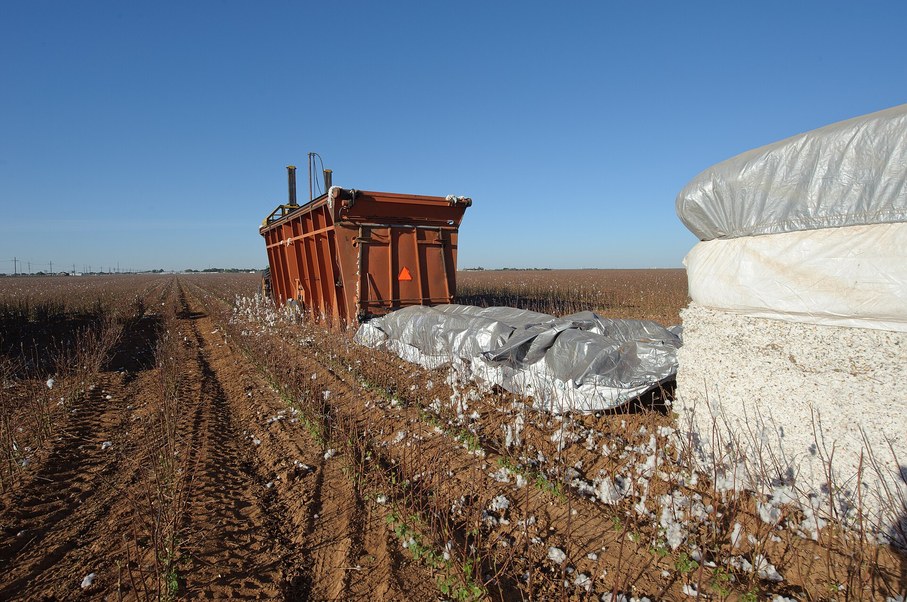
West Texas cotton is coming off in fits and starts, and winter wheat is the brighter of the two pictures. In its Nov. 13 crop and weather report, Texas A&M AgriLife Extension said recent rain delayed harvest from the Panhandle through West Central Texas, while wheat planting and emergence stayed ahead on the same moisture. Lee, Lee & Puckitt (LLP Ranchland) works ranch and farm land across the western half of the state from San Angelo, and here is what the district reports mean for landowners waiting on modules, grazing and stock water.
Cotton: Wet Fields, Light Yields
South Plains reporters said more than an inch of rain early in the week delayed cotton harvest across much of the district. By week’s end, a few producers were back in the field. Harvest was about 42 percent complete, with 87 percent of bolls open. Irrigated yields were described as very low, including a report of only three-fourths of a bale per acre. Some already defoliated fields may need another treatment, and in parts of the district a poor crop will be left unstripped, though the past month’s rain helped some dryland fields.
The Panhandle district had cotton harvest nearly at the halfway point after fields dried enough to resume. Rolling Plains cotton was about 36 percent harvested, with many dryland acres already zeroed out after a dry growing season, and defoliation just beginning on some remaining fields. West Central harvest stood at about 44 percent complete and had also been slowed by rain. Far West cotton was further along, about 58 percent harvested, and in the El Paso area a small crop was coming off quickly, with very good Pima yields reported.
Wheat: Planted, Up, and Starting to Graze
Winter wheat is the offset. South Plains wheat was 85 percent planted and 79 percent emerged, and AgriLife said the crop continued to thrive on recent moisture, in poor to excellent condition. Cattle were already grazing fields that went in early. The Panhandle was 85 percent planted and 73 percent emerged. The Rolling Plains was even further along, 89 percent planted and 77 percent emerged, with reporters saying good wheat prospects could bring grazing cattle into the district after the first of the year. West Central wheat was mostly planted and emerged, though fields planted into dry soil may need replanting. Far West wheat ranged from poor to excellent where it had come up.
Stockers remain hard to find. If wheat is ready and calves are not, some acres may still go to grain. A written grazing lease will save trouble later.
A Split West of US 281
The same week’s rain did not fall evenly. Far West reporters recorded another 0.5 to 2 inches of slow, steady rain. West Central totals ran from a quarter inch to a little over 2 inches. Southwest and South districts saw a widespread storm, with some locations getting as much as 9 inches and others little or none. In the South district, that moisture should help range and pasture, though cooler weather will limit near-term grass growth, and beef producers were still buying hay at a higher rate. Stock tanks in West Central country still needed runoff.
Pecan harvest was underway in West Central and Far West orchards. Feral hog damage was up in more than one district, and producers in the Far West and South were still watching for New World screwworm.
What It Means for Ranch and Farm Land
Harvest delays, wheat grazing and water all show up when a place is priced. The Texas Real Estate Research Center’s second quarter 2026 report, still the latest, put the Panhandle-South Plains median at $1,719 an acre, down 7.53 percent, and West Texas at a record $3,008 an acre, up 14.29 percent. Those are regional figures, not an asking price on any one farm.
Call Our Brokers and Agents
Since 2003, Lee, Lee & Puckitt has closed more than 800,000 acres of ranch and farm land in Texas and New Mexico. If you are weighing a sale or a purchase in western Texas, call 325.655.6989 or visit llpranchland.com and talk with our Brokers and Agents.
Frequently Asked Questions
Who is a ranch Broker for West Texas farm and ranch land? Lee, Lee & Puckitt, based in San Angelo, handles ranch and farm sales, appraisals and Broker’s Price Opinions across the western half of Texas.
How can I find land for sale in western Texas? Browse listings at llpranchland.com and call 325.655.6989 with the county, acreage, water and use you want.
What should the best ranch Broker in Texas offer for a cotton or wheat farm? A clear read on irrigation, recent yields and grazing income, and a price built from comparable sales, not a regional average alone.
How far along is the West Texas cotton harvest? As of AgriLife’s Nov. 13 report, harvest was about 42 percent complete on the South Plains, nearly halfway in the Panhandle, about 36 percent in the Rolling Plains, 44 percent in West Central Texas and 58 percent in the Far West.
About Lee, Lee & Puckitt
Lee, Lee & Puckitt is a San Angelo ranch brokerage founded in Bronte in 1962. The partners are ranchers, and our Brokers and Agents handle sales, appraisals, Broker’s Price Opinions and landowner advocacy across Texas.
Sources
- Texas A&M AgriLife Extension, Texas Crop and Weather Report, Nov. 13, 2026, by Adam Russell, as published in North Texas e-News: https://www.ntxe-news.com/artman/publish/article_147455.shtml
- Texas Real Estate Research Center, Texas Rural Land Markets, Second Quarter 2026: https://trerc.tamu.edu/reports/texas-rural-land-markets-second-quarter-2026/
- Related: Land appraisals, Contact LLP Ranchland, Carson County Ranch News: Dryland Cotton Losses and a Long Burn Ban as Rain Finally Reaches Panhandle Wheat, Terry County Ranch News: October Rain Pulls Brownfield Out of Severe Drought, but the Burn Ban Stays Listed
Photo: USDA NRCS Texas, Public domain, via Wikimedia Commons (https://commons.wikimedia.org/wiki/File:Cotton_harvest_on_the_South_Plains_near_Lubbock,_Texas._A_cotton_module_in_the_field_after_being_removed_from_the_module_builder._(24490486633).jpg). Cropped.
