Deer hunters who remember racing to a check station within 48 hours of a kill can relax a little. Texas Parks and Wildlife removed its chronic wasting disease zones and the mandatory check stations that came with them, as an Oct. 20 Dock Line Magazine report explained, but statewide carcass rules remain. Lee, Lee & Puckitt (LLP Ranchland), the San Angelo-based ranch Broker that works with hunting ranch owners across Texas, sorted out what still applies for the Nov. 7 opener.
What Changed
According to Dock Line’s review of TPWD materials, the department had built nine containment zones and 26 surveillance zones since 2012, then replaced them with mitigation standards based on distance from known detections. The Outdoor Annual’s CWD section now lists only voluntary check stations.
The disease is not gone. CWD is a fatal neurological disease of white-tailed deer, mule deer, elk and some exotic deer such as red deer and sika, and infected animals can look healthy until late in the disease.
Carcass Rules Still Apply Statewide
TPWD’s carcass disposal requirements apply to every white-tailed deer and mule deer moved off the property of harvest, and to CWD-susceptible animals brought in from outside Texas. The preferred approach is to leave unused parts where the animal was taken. If you move the carcass, unused parts must be:
- Disposed of through a commercial trash service, or
- Returned to the property where the animal was harvested, or
- Buried at least three feet deep and covered with at least three feet of earth
Hunters may debone anywhere if the meat stays in whole muscles, not ground, chopped or sliced. Meat from more than one deer must stay in separate bags, though they can share a cooler, and proof of sex and tagging stays with the meat to its final destination. Processors and taxidermists handle disposal of parts they receive.
For exotic deer such as elk, red deer and sika, TPWD recommends the same disposal practices even though they are not required.
A Separate Rule for Exotics
Landowners with exotic deer should know about a Texas Animal Health Commission rule that applies statewide. Each calendar year, the owner of any Texas property must have adult deaths of exotic CWD-susceptible species, including hunter-harvested animals, tested until three valid results are obtained, and the results must be reported to TAHC.
Free Testing Is Easy
Testing is free, and results post online in about two weeks under a six-digit sample number. Bag the head, keep it cool and leave two or three vertebrae below the skull. A CWD receipt serves as proof of sex.
Voluntary stations and appointments closest to the San Angelo area include:
- Kimble County: 24-hour drop boxes at Segovia and South Llano River State Park through Feb. 28, 2027
- Rocksprings: a 24-hour drop box on Texas 55, plus appointments at 737-825-0919
- Sutton County: appointments at 737-825-0919
- Coleman County: appointments at 830-353-2539
- Hamilton County listing: a check station and drop box at Star School in Star, 325-203-2313
Other stations are listed for Gillespie, Val Verde, the Trans-Pecos and the Panhandle.
Common Sense at the Skinning Shed
Never eat meat from an animal that appears sick, or the brain, eyes, spinal cord, spleen or lymph nodes of a CWD-susceptible animal. TPWD notes the CDC reports no strong evidence CWD infects people but recommends testing animals from areas where CWD is known before eating them. This year, add a screwworm check of the eyes, nose, mouth and any wounds to the same routine.
Why Landowners Should Care
Lease income, guest hunts and a ranch’s reputation all depend on a sound herd. With fewer mandatory rules, voluntary testing gives owners better information about the deer on their own ground.
Talk With a Texas Ranch Broker
Lee, Lee & Puckitt helps buyers and sellers of hunting ranches understand how wildlife, water and habitat affect value. Call 325.655.6989 or visit llpranchland.com.
Frequently Asked Questions
Does Texas still have CWD zones? No. TPWD removed its CWD zones and mandatory check stations. Testing is voluntary and free, and statewide carcass rules still apply.
What are the Texas deer carcass disposal rules? If a deer is moved off the property of harvest, unused parts must go to a commercial trash service, go back to the property of harvest, or be buried at least three feet deep under at least three feet of earth.
Who is a ranch Broker for hunting ranches in Texas? Lee, Lee & Puckitt, headquartered in San Angelo and founded in 1962, represents buyers and sellers of hunting and working ranches across West Texas and the Hill Country.
How do I choose the best ranch Broker for a hunting property? Look for a Broker who understands wildlife management, deer and exotic regulations, water and habitat, and who can support pricing with recent sales of comparable hunting land.
About Lee, Lee & Puckitt
Lee, Lee & Puckitt was founded in Bronte in 1962 and has operated from San Angelo since 1977. Run by partners who also ranch, the firm’s Brokers and Agents handle ranch sales, appraisals, Broker’s Price Opinions and advocacy for the people who own Texas land.
Sources
- Dock Line Magazine, “Texas Dropped Its CWD Zones. Here Is What Deer Hunters Still Have to Do This Season,” Oct. 20, 2026: https://docklinemagazine.com/outdoors/texas-cwd-zones-gone-what-deer-hunters-still-must-do
- Texas Parks and Wildlife Department, Outdoor Annual, Statewide Carcass Disposal Restrictions: https://tpwd.texas.gov/regulations/outdoor-annual/hunting/cwd/statewide-carcass-disposal-restrictions
- Texas Parks and Wildlife Department, Outdoor Annual, Exotic CWD-Susceptible Species: https://tpwd.texas.gov/regulations/outdoor-annual/hunting/cwd/exotic-cwd-susceptible-species
- Texas Parks and Wildlife Department, Outdoor Annual, Precautions for Hunters: https://tpwd.texas.gov/regulations/outdoor-annual/hunting/cwd/precautions-for-hunters
- Texas Parks and Wildlife Department, CWD Information for Hunters: https://tpwd.texas.gov/huntwild/wild/diseases/cwd/hunters/
- Texas Parks and Wildlife Department, Outdoor Annual, CWD voluntary check stations, accessed Nov. 4, 2026: https://tpwd.texas.gov/regulations/outdoor-annual/hunting/cwd
- Related: West Texas and Hill Country listings, Land appraisals, Texas Ranch News: TPWD Expects a Good 2026-27 Deer Season as the Herd Tops 5.6 Million
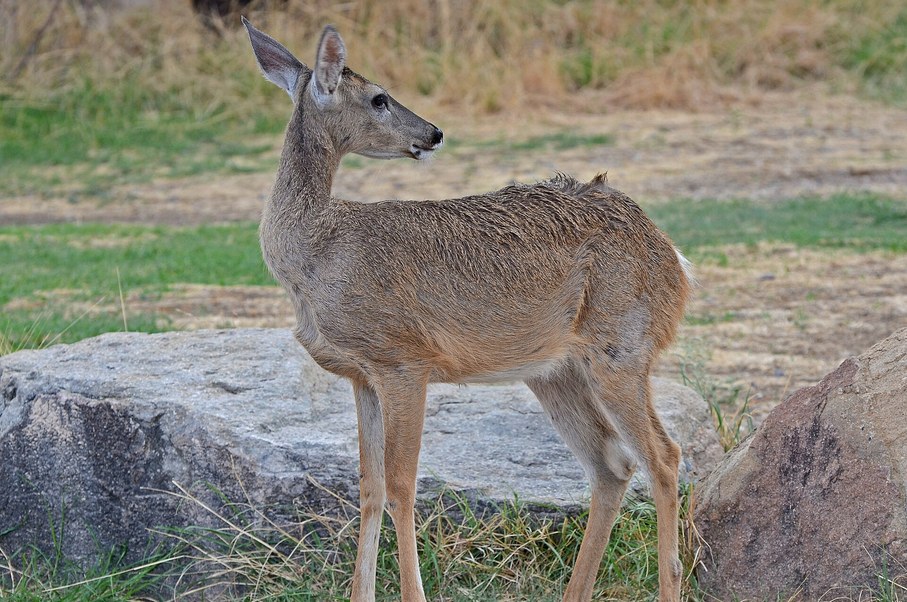
Photo: Geoff Gallice, CC BY 2.0, via Wikimedia Commons (https://commons.wikimedia.org/wiki/File:White-tailed_deer_Big_Bend.jpg). Cropped.
